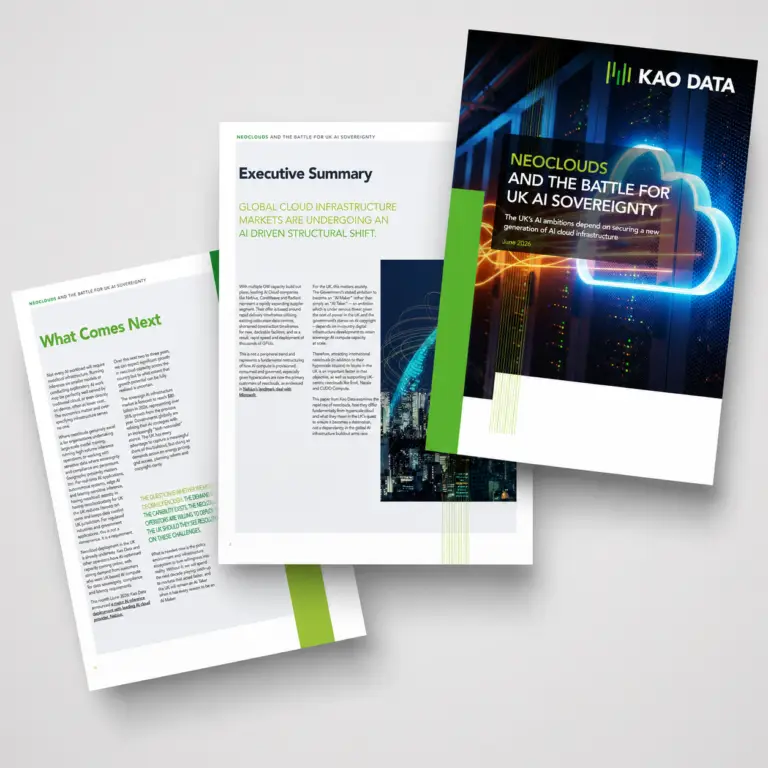
Neoclouds and the battle for UK AI sovereignty

The UK’s AI ambitions depend on securing a new generation of AI cloud infrastructure.

Global cloud infrastructure is undergoing an AI-driven structural shift. A new generation of neocloud providers is emerging to deliver the high-density GPU capacity, advanced cooling, scalable power and specialist connectivity required for AI training and inference workloads.

In this white paper, Kao Data explores the rise of neoclouds, how they differ from traditional hyperscale cloud, and why attracting this infrastructure to the UK will be critical if the country is to become an AI Maker, not simply an AI Taker.

What’s inside?

  • Neoclouds, explained. What makes this new generation of AI cloud infrastructure different from general-purpose enterprise cloud.
  • The AI infrastructure shift. Why GPU density, power availability, cooling, connectivity and deployment speed are redefining cloud infrastructure.
  • The UK sovereignty challenge. Why in-country AI compute matters for data sovereignty, compliance, latency and national competitiveness.
  • The barriers to overcome. How energy pricing, grid access, planning policy and copyright clarity could shape the UK’s AI future.
  • The opportunity for the UK. Why the UK has the talent, demand and data centre capability to become a destination for AI infrastructure deployment.

FAQs

No. It is written for cloud, AI, infrastructure, policy, planning and business leaders who need to understand how AI infrastructure decisions will affect the UK’s digital future.
Yes. The paper explains how neoclouds differ from traditional cloud providers, why they are optimised for GPU-intensive workloads, and how their role is evolving from GPU-for-rent models to managed services and full-stack AI platforms.
Yes. The paper explores why sovereign AI infrastructure matters, what is currently holding the UK back, and what needs to change for the UK to capture more AI compute deployment.

Fill in the form to download the white paper and explore how neocloud infrastructure could shape the UK’s AI future.

We’ll only use your details to share this white paper and relevant insights. You can opt out at any time. See our Privacy Policy.

Who should read this?

This document is designed for cloud, AI, infrastructure and enterprise technology leaders, as well as policymakers, investors and industry stakeholders looking to understand the next phase of AI infrastructure growth.

It will be particularly relevant for organisations evaluating AI compute strategy, sovereign cloud requirements, high-performance GPU infrastructure, or the role of UK-based data centres in supporting future AI workloads.

Why now?

AI is changing the economics, architecture and geography of cloud infrastructure. Neoclouds are growing rapidly because traditional data centre and cloud models were not designed for the power, cooling, density and networking demands of large-scale AI workloads.

For the UK, the opportunity is significant. It has world-class AI research, strong technical talent, established data centre capability and growing demand for sovereign compute. But without action on power costs, grid access, planning reform and copyright clarity, the UK risks missing the next major wave of AI infrastructure investment.

The demand is there. The capability exists. The question is whether the UK can move decisively enough to turn neocloud interest into deployment — and move from AI Taker to AI Maker.

Test Text

test job title

Details

If your application is successful, Harlow Council will transfer the grant by BACS.  Bank details (account name, number and sort code) will need to be supplied with a summary of accounts. 

Funding conditions:  If your application is successful, your project must be delivered by 31 December 2026. You will have to return any grant funds if the project is not delivered or the organisation receiving the funding stops operating.

A contract agreement will need to be signed between your organisation and Harlow District Council before any funding is granted.

Monitoring and Evaluation: Grant recipients will be required to provide an end of project report to establish whether the project has met its aims and objectives, as well as to assess the overall impact on participants. Funding for the project is provided on the basis that the Project Evaluation form is returned within the agreed project timescale (no later than 31 January 2027).

Risks and Liabilities: In giving grants the ‘Harlow Council’ will require the supported project organisation or groups to accept all risks and liabilities associated with the activity being supported. This will be a condition of the grant.  Copies of relevant documents may need to be provided if the application has been approved.

Data protection statement – how we will use your information

The Council is committed to handling your personal information in line with the data processing principles.  The Data Protection Legislation and the General Data Protection Regulation 2016/679 (GDPR) sets the legal framework for how we collect, handle and process personal data and for your rights as a ‘data subject.’

General Data Protection Regulation:  Personal data provided by you will be processed in accordance with this protocol. For more details, please see https://www.harlow.gov.uk/privacy-notice

Thank you for taking the time to read these guidance notes. If you have any questions, please get in touch with [email protected].

FAQs

  1. Who can apply?
    The fund is open to not-for-profit community groups and grassroots initiatives based in Stockport.
     
  2. What types of projects are eligible?
    We encourage projects focused on environmental sustainability, community cohesion, and local economic development.
     
  3. How much funding is available?
    Grants range from £500 to £2,500 for pilot projects or to enhance existing initiatives.
     
  4. Is this the sole funding for this project?
    If not, please expand on the additional match funding that you currently have or are in the process of applying for.
     
  5. Are there any restrictions on grants under £500?
    Yes, please note that grants under £500 may be subject to different guidelines or restrictions, which will be communicated upon application.
     
  6. When will we know if our project was selected?
    Notifications will be sent by March 31, 2025.
     
  7. How can I apply for a grant?
    Applications can be submitted through our online portal, where you will find detailed guidelines and forms.
     
  8. What happens if my application is unsuccessful?
    If your application is not successful, we encourage you to seek feedback and consider reapplying in future funding rounds.
     
  9. When is the application deadline?
    Please check our website for the latest application deadlines and any upcoming funding rounds.