Transparency is a word our industry uses often, but one it has not always lived up to.
In practice, it’s about open and honest communication, so that people, especially those affected by an organisation’s operations, can trust and hold it to account.
During the last three years we’ve seen the transparency of data centres called into question time and time again. Our industry has gone from the hero of the AI Opportunities Action Plan to the villain in the AI story, and one might argue that with that change in perception, transparency about data centres has, unfortunately, all but gone out of the window.
From the bright blue, eye-catching images of the Sunday Times, to the misinformed debate about water, in the UK data centres have become a mainstay of national media headlines, and too often, not for good reason.
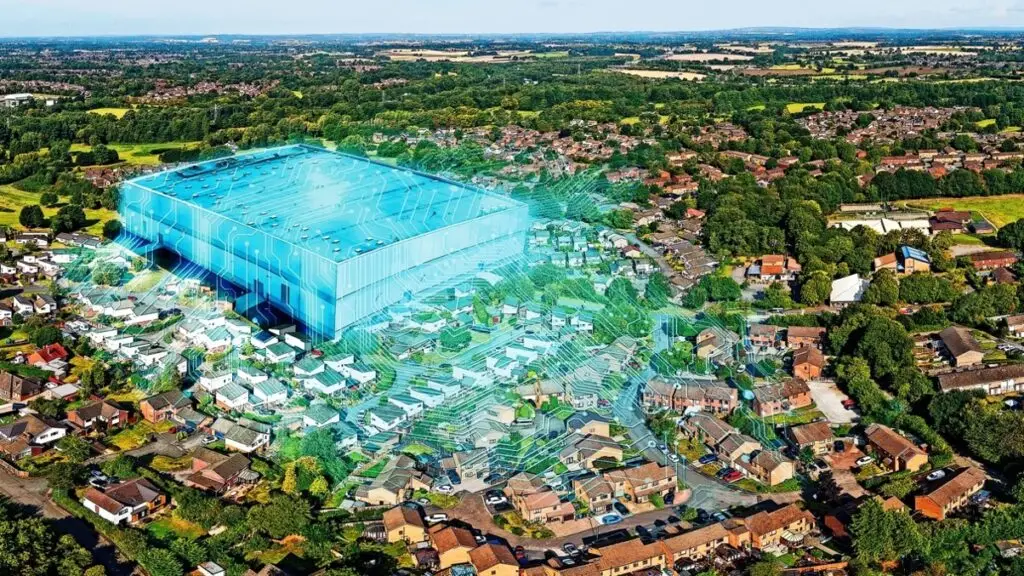
ILLUSTRATION BY PETE BAKER From the Sunday Times – 15/08/2026
In recent weeks, we have seen community concerns about our industry rise significantly, with in-person protests taking place in Scotland, England, and further afield across Europe.
As the CEO of one of the UK’s data centre platforms, it’s not my place to preach about the importance of transparency. But as one of the companies’ continuing to challenge the many misconceptions about data centres in the national press, I do believe that our industry holds some level of accountability for the swathes of stories and opposition, and to address them, we must continue to engage openly, in the mainstream and be prepared to discuss both the good and the bad of our industry.
Not all headlines are equal
The fact is that explaining what we do, and why we do it, is our responsibility. We need to better communicate the benefits of our industry and the value that data centres can create, be that through AI innovation, job creation, attracting investment, or working with local communities. Today, there is a clear gap between what data centres really do and what many people believe they do, and every question we leave unanswered only serves to widens the lack of clarity, that surrounds this vital industry.
In response to growing community concerns, we were recently proud to host BBC Countryfile at our Harlow data centre campus, where alongside other members of the industry including techUK’s Sophie Greaves, we were able to challenge the misconceptions about the industry and set the record straight. This was, in my opinion, one of the more balanced, fair and in-depth looks at our industry to date, and challenged the very idea that data centres drink the rivers dry and ruin the countryside.
Many, like us at Kao Data, believe that data centres, if built in the right place, can play a critical role in the green transition, and this was a sentiment echoed throughout the programme.
Importantly, to ensure that data centres are built in the right way, it is incumbent upon our new PM to develop a joined-up planning strategy along with National Grid and NESO as part of the new Data Centre Covenant, one that not only enables communities to see the benefits of AI and data centre investment, but also ensures those facilities become the magnet that delivers growth in every postcode.
While we wait for more details regarding the covenant, however, I thought it might be pertinent to explain the facts surrounding our data centres, so that anyone seeking to learn more about our platform has all the answers exactly when they need them. For those interested, many can also be found within our recently launched Data Centres Explained initiative.
Data centres and water use
This summer was one of the hottest on record. But the idea that data centres are going to ‘drink up’ national water supplies simply isn’t true.
As part of the BBC Countryfile feature, the programme’s own research estimated that data centres consumed 2.26 billion litres of water in the last financial year, which is less than half a percent (0.5%) of the water supplied to all UK businesses and other non-household users.
At Kao Data, our newest data centres will use a closed loop cooling system, allowing them to be filled once and the water within them to be recycled.
Data centres, energy and the AI economy
Access to powered land is another crucial UK issue, and one made worse by irresponsible developments and landowners seeking to capitalise on the AI race.
While Ofgem continues to work through its ‘proposed data centre connection reforms’, the truth is that the country needs just 7 to 10 GW of new data centre capacity to support a flourishing AI economy, and none of that compute needs to be placed near the crowded hubs of London.
To that point, there is also no need for data centres to be built on greenbelt, and today there are hundreds of derelict, brownfield sites across the UK which are ripe for redevelopment.
In fact, at Kao Data, all our data centres are placed on ex-brownfield sites, or in places deemed Strategic Industrial Locations, showcasing our commitment to build in places where we can have a
material, net-positive impact and create social value for local communities.
For example, by capturing some of the aforementioned AI opportunity, and turning ex-cement plants into silicon factories, data centres can help create jobs, encourage inward investment and be a good corporate neighbour for the communities they build in.
Data centres and job creation
Another misconception is that data centres don’t create jobs, but our research into the West London data centre cluster found it had created more than 14,000 jobs and contributed over £30 million annually in local business rates.
By replicating that in another 10 or more locations across the UK, we believe that as many as 140,000 new jobs could be created to support data centres, spanning architecture, construction and engineering, as well as facilities management, maintenance engineering, procurement and contract management. The industry could also deliver a further £300 million or more in local business rates.
Moving forward with transparency
With data centres firmly in the spotlight, transparency is going to be crucial for our industry, and calls for detailed data about energy and environmental impacts are, in my opinion, the bare minimum any operator should be disclosing. For our peers who haven’t yet made transparency a cornerstone of their operations, time is now of the absolute essence.
For anyone seeking information about our platform, our environmental credentials can be found within our annual ESG report, which contains data about our energy and water consumption, and our work with local communities.
Of course, transparency cannot rest with any one operator alone. That is why we launched Data Centres Explained, a free public education hub that takes visitors on a virtual tour of a data centre, zone by zone, and answers the questions communities are asking about water, energy, construction and local jobs. With techUK now on board as a Strategic Partner, it is fast becoming a trusted place for anyone to find the facts.
So, if you have a question about data centres, or want to understand what one might mean for your area, visit datacentresexplained.com and ask it. Every question receives a direct answer. And to my peers across the industry, I would encourage you to lend your knowledge to it too. The narrative gap will only close if we all choose to fill it with facts.