In the Star Wars universe, the Force binds everything together – past, present, and future. George Lucas understood something profound about place and legacy which he knew would be a hit with audiences that related to and cared about it: the ground beneath your feet carries the story of everyone who stood there before you. That idea has stayed with me for a long time. And it’s why, when I stood amid the ruins of Harlow’s former technology heartland in December 2011, I felt something more than commercial opportunity. I felt the next act in a story emerging, and the obligation to write a new chapter in it.
But I am getting ahead of myself.
It was April 2012. The UK was in the midst of a double-dip recession, April was on its way to becoming the wettest month on record, and spirits weren’t particularly high as I drove through the sodden streets of Harlow under a heavy, overcast sky. Yet, as another famous figure once said, it’s always darkest before the dawn. Few phrases have proven more accurate when reflecting back on my relationship with this town and what it has become.
This was the site of Standard Telecommunications Laboratories, where in 1966 a young physicist named Charles Kao first demonstrated that light could travel through glass fibres with remarkably low signal loss. A discovery so consequential it would win him the Nobel Prize more than four decades later and lay the foundation for the modern internet. Harlow wasn’t just a commuter town on the M11 corridor. It was the birthplace of fibre optics, innovation embedded in its very soil.
The site had passed from Standard Telecommunications to Northern Telecom, the Canadian giant that became Nortel Networks. For a generation of Harlow residents, Nortel was more than an employer. It was the anchor of the community: a place where families built careers spanning decades, where 2,500 people came to work each day, where the social club and the sports facilities and the subsidised canteen were woven into the rhythm of the town. Then, in January 2009, Nortel filed for bankruptcy, one of the largest corporate collapses of the financial crisis. The Harlow site closed virtually overnight. As the council’s own project director later put it: the closure was “horrendous for the town.”
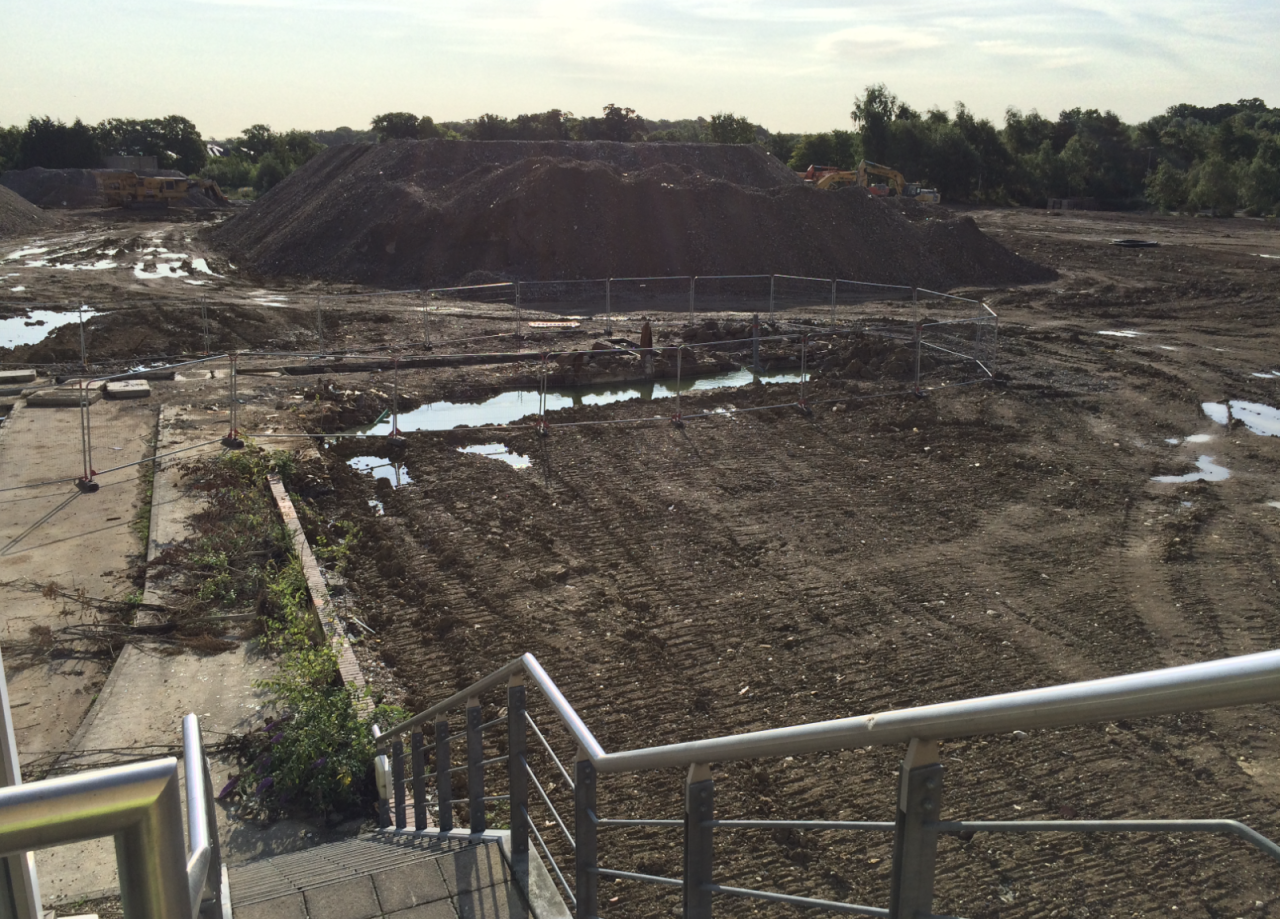
Above: The site in Harlow back in April 2012. Thankfully it stopped raining…
That wound was still raw when I arrived. What greeted me wasn’t a field full of potential. It was 500,000 square feet of derelict and vacant offices: silent corridors, emptied laboratories, the physical memory of a workforce that had simply ceased to exist. But Harlow had not given up, and neither had I – it was a case of ‘do or not do, there is no try. Working with the council and government, we secured enterprise zone status for the former Nortel site and the surrounding land in 2011, a declaration that this place still mattered and that its future was worth investing in.
Then we got to work.
I secured 43MVA of power alongside the site. I vividly remember people questioning whether I had lost my mind. Why commit to that amount of power for an industry still very much in its infancy? It was only two years previously that “data centre” had even been added to the Oxford English Dictionary. As I walked the site alongside my colleague Matt Harris, both of us sheltering beneath oversized umbrellas, the feeling of being a pioneer was impossible to ignore, though we were hardly the first pioneers to stand on that ground. One sharply dressed analyst was only too happy to tell me it would take 32 years to sell the capacity I had just purchased. By that point, I might start resembling George Lucas myself.
There was another challenge. We were building to the north-east of London, not in the established data centre heartlands of the west. More than a few eyebrows were raised. Surely power in West London would always be plentiful? Why would major compute workloads ever need to move?
Little did they know. We pressed ahead regardless, not just as builders of a data centre campus, but as partners to a town that deserved a second act.
The industry itself looked very different in 2012. This was before AI as we know it today, and even hyperscale cloud was still emerging. Much of the UK’s compute remained on-premise, while financial services firms dominated demand. In those days, a “large” contract was typically around 500kW, with the average wholesale colocation deal closer to 275kW. We were building for a world that didn’t yet exist.
Fast forward to 2026. This week, following the announcement that leading AI cloud provider Nebius will deploy 22MW of AI inference infrastructure across two data centres on the campus, that original 43MVA is now fully contracted. It took 14 years, not the 32 that was predicted.
The Force, it seems, is strong with us.
For Kao Data, our investors, and everyone who believed in the vision, this marks another major milestone. More importantly, it validates a conviction we held from the very beginning: that Harlow could become one of the UK’s most important hubs for advanced computing and AI infrastructure. The town that gave the world fibre optics now hosts some of the most advanced AI infrastructure on the planet. That continuity, from Sir Charles Kao’s Nobel Prize-winning experiments to Nebius deploying 22MW of AI inference on the same ground, is not incidental. It is the whole story.
The transformation of Harlow reflects the extraordinary pace of change across our industry. As technology becomes increasingly embedded in every aspect of our lives, data centres are experiencing unprecedented levels of investment and demand. Development cycles are shortening, infrastructure requirements are growing, and records set one year are routinely surpassed the next.
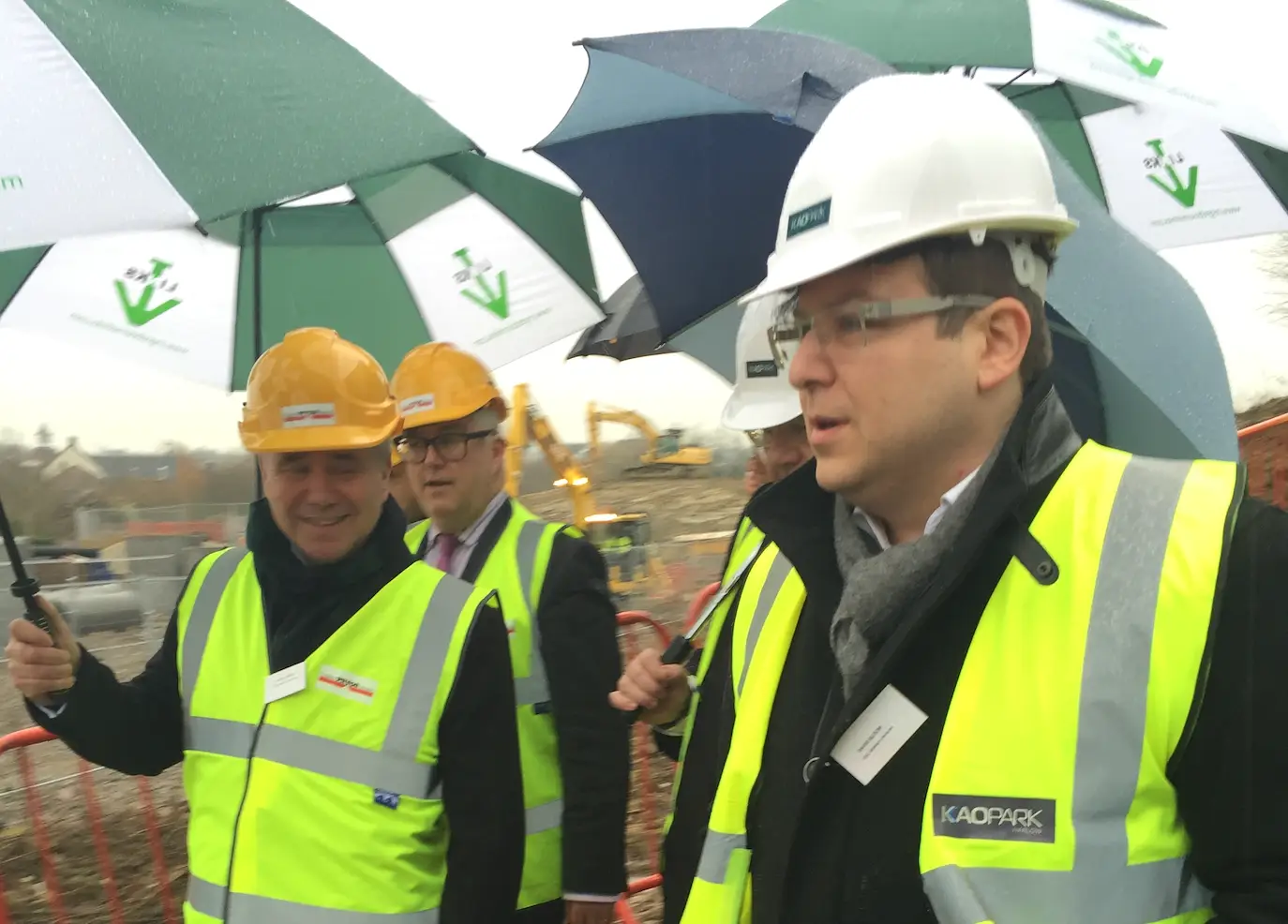
Above: Walking the site. It started raining again pretty soon…
What’s particularly striking is that, despite the challenging macroeconomic environment we face today, one that echoes many of the conditions we saw back in 2012, demand for industrial-scale AI infrastructure in the UK remains exceptionally strong. The infrastructure we’ve built at Kao Data is proving to be exactly the type of platform that the world’s leading AI innovators want to call home.
The speed of the Nebius agreement demonstrates how dramatically our market has evolved. Colocation deals once took many months, sometimes more than a year. This partnership was agreed and completed in a matter of weeks, a testament both to the expertise of our team, who have consistently designed and delivered highly scalable and flexible facilities, and to the agility, professionalism, and technical capability of the Nebius team.
Beyond the commercial significance, this moment is personally satisfying for two reasons.
First, it demonstrates the strength of the collaborative leadership culture we’ve built at Kao Data. Following the recent announcement of my long-time colleague Spencer Lamb as CEO, this transaction is another example of how closely our leadership team has worked together for many years.
Second, it creates the foundation for the next chapter of growth. With new developments planned in Park Royal, Greater Manchester, and further expansion here in Harlow, we remain committed to delivering the industrial-scale computing infrastructure that will underpin the UK’s sovereign AI ambitions for years to come.
Fourteen years ago, standing in the rain amid 500,000 square feet of empty, silent offices, on ground that had already seen greatness, survived loss, and been given a second chance, the future was difficult for many people to see.
Today, it feels a lot closer. And in Harlow, perhaps more than anywhere, we know that the distance between dark and dawn is shorter than it looks.